


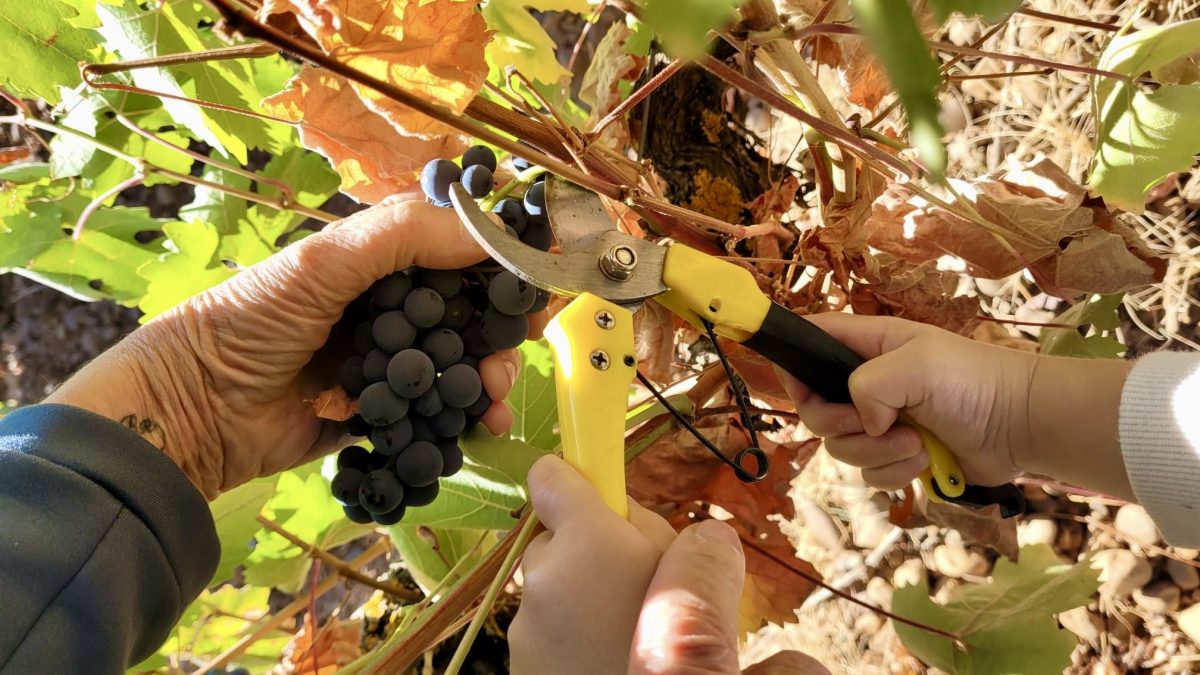
Of the 2,844,769 kilos picked, Prieto Picudo leads production with 2,064,817, most of which will go into making rosé wines, although magnificent long-aged reds are once again expected
The native white Albarín, despite a larger vineyard area, loses almost 89,000 kilos on the previous harvest, and with the 439,000 picked from its 101 hectares of plantings it will have to meet growing demand
The whites of the vintage will once again be especially aromatic, fresh and fruity; the rosés will keep their extraordinary finesse and fragrance, and the reds promise to be very varietal, highly expressive and strong in character
Valencia de Don Juan, 17 October 2026
- Start/end date: 19 August/13 October
- Registered area: 1,213 hectares
- Productive area: 588.22 hectares (22.16 more)
- Number of plots: 830
- Number of registered growers: 201
- Number of registered wineries: 35 (26 received grapes)
THE HARVEST IN FIGURES
| VARIETIES | GRAPES PICKED (kilos) |
|---|---|
| – Main red variety 1: Prieto Picudo | 2,064,817 |
| – Main red variety 2: Mencía | 8,773 |
| – Main red variety 3: Negro Saurí | 5,400 |
| – Authorised red variety 1: Tempranillo | 163,680 |
| – Main white variety 1: Albarín | 438,979 |
| – Main white variety 2: Verdejo | 152,960 |
| – Main white variety 3: Godello | 10,160 |
| Total | 2,844,769 |
The wineries and growers attached to the Regulatory Council of the León Designation of Origin concluded the 2026 harvest, marked above all by the abnormal weather of the hottest summer since reliable records began, with 2,844,769 kilos of grapes picked (compared with 3,008,365 the previous year and 2,829,211 in 2024), which represents a 5.44% drop in production on 2025. The spring hailstorms, especially the one that hit the Valdevimbre area on 28 April, home to a third of the vineyard, and the almost complete absence of rain in July and August considerably reduced the size and weight of the grapes and broke the forecasts, which initially pointed to more than three million kilos. Nevertheless, they barely interrupted work in the vineyard and allowed an orderly, staggered harvest under perfect ripening conditions, with balanced overall parameters and in perfect health, which in that sense points to a very good vintage for its wines.
The harvest, which ended on 13 October although it was mostly completed in September, had begun on 19 August, almost three weeks early (exactly 19 days) compared with the two previous campaigns (7 September), which had already brought a significant advance on traditional dates. This is the consequence of an extraordinarily hot summer with minimal rainfall, which highlights the effects of a threatening climate change.
The forecast of the technical department of the León Designation of Origin, of slightly more than three million kilos, initially similar to or perhaps slightly higher than the 2025 figures, could not be met in the end because of these weather conditions affecting the vineyard, especially from veraison onwards. A rainy spring had allowed the subsoil to build up good moisture reserves and flowering and fruit set to develop completely normally. But the severe drought from July until after the harvest had started and the excessive heat, especially throughout August and even the first weeks of September, with very high temperatures, hardly any difference between day and night temperatures and unusually tropical nights, raised fears of a drop in production that was finally confirmed in all production subzones.
In the weeks before the harvest began, the vines were already showing signs of water stress and the grapes showed evidence of dehydration, accelerating sugar concentration, preventing them from growing in volume and, consequently, even reducing their weight. In addition, the very light and localised rains of the last days of August and first days of September had little of the desired effect on the fruit, beyond lightening its balance and containing alcohol levels.
However, it was precisely that summer heat and the dryness at the end of the growing cycle that prevented pests and produced well-formed, homogeneous, clean bunches of smaller grapes, but in extraordinary health and of the highest quality, which points to great wines for the 2026 vintage. The 5.44% drop in production breaks the 6.3% growth of the 2024 harvest and places the León DO slightly below three million kilos again, in an economic scenario that, as of today and although the circumstances and causes are different, remains adverse for consumption in general and for wine in particular.
In this context, the queen variety Prieto Picudo accounts for most of the red production with 2,064,817 kilos (2,140,492 in 2025); Mencía holds steady (8,773 compared with 8,778), practically symbolic although also a main variety for making rosé and red wines; and the complementary Tempranillo recovers (163,680 compared with 148,160). Negro Saurí increases (5,400 compared with 2,780). The amendment of the Regulatory Council’s Product Specifications (Pliego de Condiciones) to include it as a main variety, when it had practically disappeared, enabled the production and marketing of a second wine, also a rosé, by the growers’ company Melgarajo (Melgar de Abajo-Valladolid). This grape, although known by other synonyms in El Bierzo and Galicia (Merenzao) and northern Portugal (Merençao), has always been present in the León DO territory and was at one point included by Itacyl in the programme to recover historic native varieties of the designations of origin of Castilla y León. Its production is still symbolic, but it stands out for its excellent organoleptic qualities. Among the reds, Garnacha, authorised but no longer in use, once again recorded no harvest.
The setback comes from the white Albarín, with 438,979 kilos compared with 527,764 in the 2025 harvest, a blow for the wineries, which will not be able to meet the growing demand for an emblematic white of the León DO that had been raising high expectations for its quality, uniqueness and distinctiveness. The relegated Verdejo also falls again (152,960 kilos compared with 173,411 in 2025), while Godello remains at almost residual figures, though improving its yield (10,160 kilos compared with 6,980 in the previous harvest). Both are main white varieties.
Mechanised harvesting (almost 93% of the vineyard register is trellised) made it possible to pick under the best conditions of ripeness, alcohol and acidity. The grapes showed an excellent skin-to-pulp ratio and very good overall parameters. Winemakers unanimously highlight the excellent qualities for making wines with the reference varieties, Albarín and Prieto Picudo, and above all the enormous aromatic potential of the white, which, as in 2025, is well above even its usual high level. The whites will be very terpenic, floral, fruity and fresh on the palate thanks to the characteristics of the varieties themselves, especially the Albarín wines, balanced and also highly suited to complex winemaking.
Prieto Picudo, mainly used for rosé (which accounts for 68% of total production), will produce wines of great varietal purity, aromatic and with a very good balance between alcohol, in response to demand in that regard, and the characteristic acidity that always gives it freshness. Once again, winemakers will face the challenge of managing these exceptional fruit conditions to make reds that, with excellent ageing potential, even long ageing, will probably recall those of the best vintages. They will be wines with strong typicity, with all the power and rusticity of a difficult variety like Prieto Picudo, but with the pleasant finesse, silkiness and elegance that have characterised those of recent vintages.
The León Designation of Origin concludes a harvest of 2.85 million kilos of very good grapes reduced by hail and heat


Follow Us